
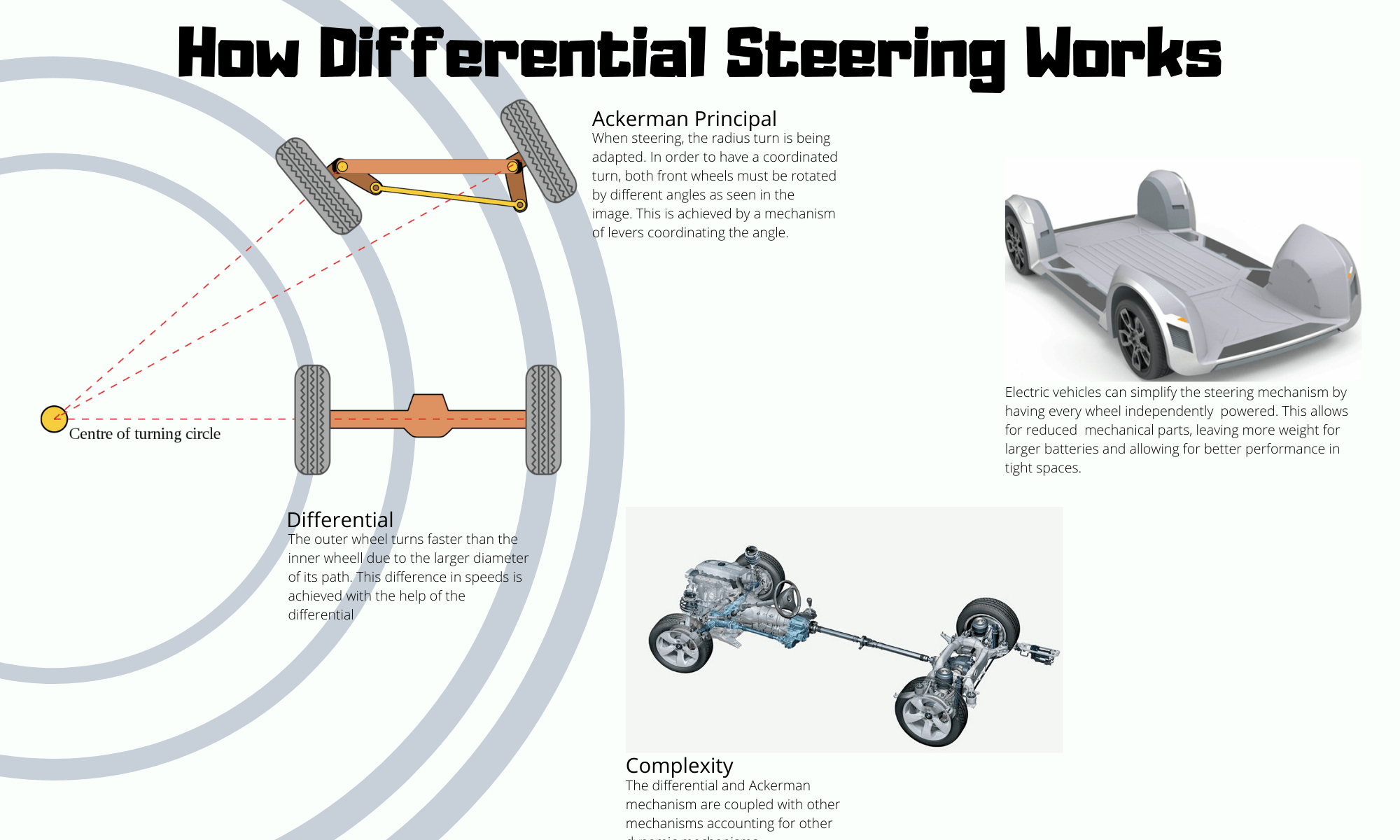
Starting this project was the hardest thing to do. I am currently developing an autonomous land-surveying robot for my Mechanical and Aerospace Engineering senior project. While designing the chassis of the robot, I came about the challenge of selecting the appropriate steering mechanism. This is the foundation of any moving machine and I did not respect its complexity until this point. I decided to create an infographic about differential steering, commonly found in almost all street cars. Per the project’s parameters, I started with two academic journals on the mechanics of differential steering. Interestingly enough both of these papers mentioned autonomous vehicles and robotics when assessing the mechanisms.
Creating a design from the plethora of information provided through these papers proved to be challenging. As an engineer, I am always given a problem with schematics and drawings, detailing the parameters of the problem or leaving me to explain certain sections of the drawings. Here, the process is completely different. The task at hand is now to create visuals and explanations given all the information. The first design decision I encountered was choosing what to make my infographic about. Initially I just wanted to jump in and nerd out about every piece of the differential steering system to educate the reader about its beauty and complexity. After talking to Professor Sheila, I realized this was the wrong approach. Every visual explanation has a motive, once that motive is defined the direction for design is more clearly defined. Reading through the papers and working on a related project myself, I found it a good motive to try and prove why differential steering in electric vehicles is more effective, efficient, and simple than those in common two-wheel drive, gasoline powered automobiles.
A critical point of this design was to discuss the turning radius of cars and how everything has to line up to make a coordinated, safe turn. This led me to the design choice of implementing a radial grid to my design. This allowed me to create an entry point as well. The title of the infographic violates the radial grid pattern, which (along with the increased text size and boldness) makes it stand out and be the first thing the reader pays attention to. Naturally, the next place the reader looks is the center of the grid, which is the left side of the 11 x 17 in. layout. Here I take the opportunity to detail the turning radius of a vehicle and how every wheel must line up perfectly for a turn. This is the basis for any steering mechanism and allows me to lay down the foundation for further discussion. The information then continues to flow as I explain the complexity of commonly applied mechanisms and eventually transitioning into the electric vehicle steering mechanism.
The graphics were a critical component of the design and choosing which images to use was difficult. When it came to explaining the mechanism, I found simplified models to be very effective. I found a simple model of a chassis and wheels to serve as the foundation and then I had to modify the graphics by including guides to depict the angle of the wheels. When discussing more model-specific parts of the steering mechanisms I chose to include realistic images of vehicles in order to give the reader something to relate the differences to.
Font was another challenge to overcome. It’s easy to stick with the basics and something that makes everyone comfortable but I felt like giving the visual explanation a better engineering feel. The font I chose was Adumu Regular, which turned out to be inspired by the wilderness of Africa and not at all engineering-related. However, I felt like the font was aggressive enough to call attention, but not too much as to distract the reader.
For the color scheme, I chose to keep it light. The background is white with the main colors being gray and light yellow. I chose this color scheme because it gave enough contrast to allow the reader to differentiate different mechanism parts. At the same time, the color scheme is not over-powering and allows the reader to be more relaxed while navigating the infographic.
The visual explanation is still under development and I am sure there is a lot more iterating that has to be done on my end in order to reach a final version. There’s a lot more information to include and I feel my direction/motive changing even as I write this paper. Once all this is defined I will be that much closer to reaching a final product, ready to roll out and ask request feedback.
 Design For Understanding