
*For context, I’m a Woody Woo major 🙂
The goal of this design was to explain some key findings about social mobility in the United States and how that relates to the achievement of the “American Dream”. In order to do this effectively, it aims to first define what social mobility means in this context, how we can measure it, and why it is a good indicator of the achievement of the American Dream.
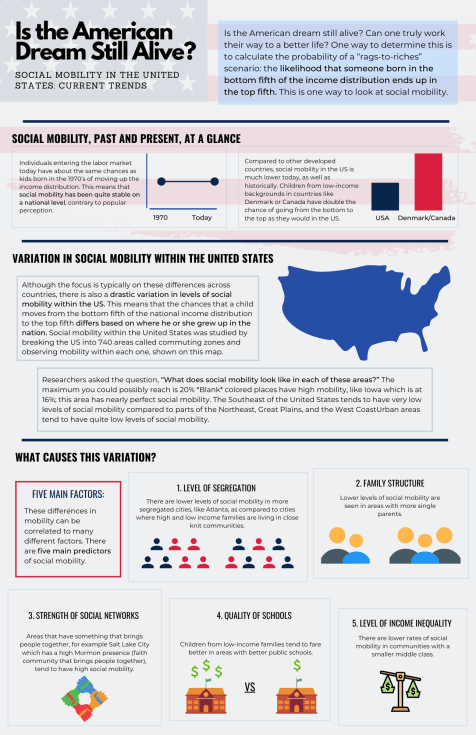
I think that it is relevant and useful to talk about the American Dream because it is something that most people in this country understand and aspire to. It matters to not only policy makers and sociologists, but to normal people to know if America truly is a “land of opportunity” and if it will continue to be for their children. The whole premise of this graphic is that social mobility ought to be high in a place like America that promises everyone a fair chance at achieving their dreams.
There are four sections to the design. The first contains the title and a summary overview posing the question that is being investigated and teases at the information that will be provided. The main point here is that we will be able to investigate the viability of the American Dream by looking at the probability of a “rags to riches” scenario, or one where a person goes from being very poor to being very rich (which supports the American narrative of anyone being able to work hard and make a great future for themselves on their own merit).
The second section, “Social Mobility, Past and Present at a Glance”, gives some context before we delve deeper into the investigation. It explains that historically, social mobility (again, the probability that someone will go from the bottom level of the income distribution in the US to the highest) has been the same over the last 50 years. This means that it has not gotten easier nor harder to work your way to a better life in the US. The second point made here is that compared to other countries, the United States does not have very much social mobility at all (it is much more difficult to improve your lot in the US than in other developed countries).
The third section, “Variation in Social Mobility Within the United States”, explains that while comparisons about this are usually made across countries, there are interesting findings to be made when we look at social mobility within the US alone. The most striking one is that social mobility actually differs a lot depending on where someone grows up. Here, I wanted to illustrate how social mobility varies a lot across the nation by creating a type of heat map (darker areas where there is more social mobility and lighter where there is less), although I don’t know how to do this exactly and would like some guidance on how I might attempt it.
The fourth section, “”What Causes This Variation”, is the part that is most relevant to the public as well as policy makers, as it points to the observable trends behind this, which can give some insight as to how we can combat the issue of limited social mobility in some regions of the US. The main ideas here are that social mobility is most impacted by five main factors in any given location: level of segregation, family structure, strength of social networks, quality of schools, level of income inequality. This is essentially the “so what” of the design. If we know that social mobility hasn’t changed much, that it’s way lower than other developed countries, and particularly low in certain parts of the US, we want to know what is causing that so we can start to figure out how to fix it.Please let me know if that idea comes through! This is something that needs to be “fixed” because the hope of social mobility is the very ideal that America was built on.
I delineated different sections by clearly blocking them off with a line and titling them with subtitles that remain consistent throughout. I use boxes to contain each individual body of information that all have the same font. Font size is also used to try and show hierarchy (larger font is usually offering contextual information while the smaller fonts go with the graphics to offer explanations). I did use a good amount of color, but I tried to limit them to red, white, and blue to keep with the American theme, and tried to only deviate from the standard dark navy blue when something really needed to be differentiated. I added a semi-transparent American flag in the background to try to add some interest and make it more aesthetically pleasing, but I’m not sure if it’s too distracting or if it really makes it too difficult to read, so please let me know! I also did use a grid when designing this to make sure all of the margins are the same (mostly). Let me know if this misalignment of the top margin of the last three boxes is distracting. I tried to align them but it doesn’t really work because of the different amount of text in each box.
Thanks so much, I really appreciate your feedback!
 Design For Understanding
Hello, Natashia! I really, really like your draft.
I think you have created a clear structure with your four levels of information and clear delineation between sections, both with your subtitles and the lines dividing the sections of your draft.
Your title provides a clear entry point into your topic, complete with a subtitle and a paragraph briefly explaining what your project is outlining.
As for design, I know you mentioned how you worried about the American flag background, but I thought it was good and made sense in this context. I thought your use of color was very strong as well. However, I think you have a lot of variation in fonts sometimes, which might make sense because they differ between levels, but it may be something you want to look at. More specifically, I am looking at the font of your subtitle, “Social Mobility in the United States: Current Trends.”
I believe the strongest part of your draft is your bottom section, “What Causes This Variation?” Your graphics clearly represent what is happening in your text, and there is less text as a result. You have clear structure here and seem to have thought a lot about the concept and how to break it down in an understandable way. The weakest part of your draft is your middle section, “Variation in Social Mobility in the United States.” There is a lot of text, and despite the appearance of a map of the continental United States, and knowing that you want to show the zones on it, this section is significantly less approachable than the rest of your work. Perhaps you could break up the text more, giving your “commuting zone” content its own paragraph, and making sure your paragraphs fit in a readable way into your grid.
Overall, I really liked your draft, and I’m excited to see the next iteration!
LikeLike