
What is Effective Information Design?
As we learned in the first lecture, information design can be defined as something that instructs, and/or explains a concept while also supporting analysis, exploration, decision-making, and reasoning. Information design is most effective when it supports knowledge transfer. We can create designs that are conducive to knowledge transfer when we understand that the key to effective design is that they do not remove the complexity, but rather explain them in a clearer way. There are five main principles of effective communication design:
- Clear definition of categories and story
- Well-defined hierarchies
- Appropriate use of visual language
- Purposeful use of visual variables
- Logical visual structure of the information
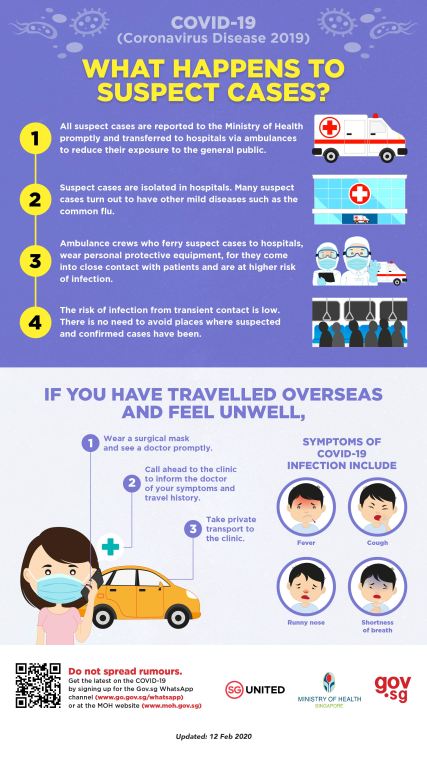
In order to delve deeper into these concepts, I will be analyzing three different examples of information design and evaluating their success in these respective categories. I chose to look at information graphics about Covid-19 from three different countries, as the virus is ever present in all of our lives right now. The first is a graphic from Singapore. Lately Singapore has been lauded for the efficient and effective way it has been dealing with the virus, so I figured it might be worthwhile seeing if their information design is particularly intuitive and if that may play a part. I also studied abroad there last semester, so I know for a fact that the Singaporean government is a big fan of using posters all over the city state to promote their agenda.
I would consider this design to be quite effective. When we first look at the graphic, the entry point is clear, as our eye is drawn to the large, yellow bolded font at the top of the page. While yellow can sometimes be a risky color to use in information design, it works well here because it is used on top of a purple background, it’s complimentary color on the color wheel. This contrast makes the text easy to read.
We then go down and see the important information points are numbered. The only comment I would make here is the fact that the numbering suggests that there is a sequential aspect to the information, which would make sense for example if they were explaining the steps they would take if there was a suspected case of corona. This is not quite the case however, as the numbered paragraphs simply explain different precautions and useful information in the event that there is a suspect case, in no particular order. This can be a bit misleading. What is done very well in this section however is the fact that each image is not left alone, but rather “anchored” with text. While the third image for example does show ambulance workers wearing protective gear, it is really important that the text conveys that as well for optimal clarity, which they did.
The second half of the graphic makes a transition by switching to a gray background which helps make clear categorical definition. The change delineates that the graphic has moved on from talking about what one should do if they were recently traveling overseas (again, the large bolded font makes this movement to another important topic clear, making good use of hierarchy). This section also makes use of similar strategies mentioned above by labeling each image with a helpful caption.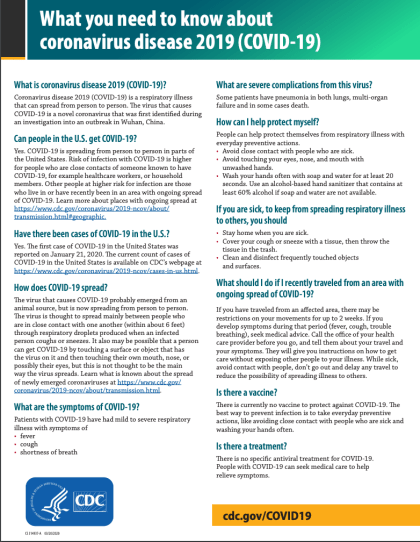
The next image I chose is from the United State’s Center for Disease Control. Here the entry point is also very clear, as the title is very clearly stated at the top in a large font size. One thing I note right off the bat is that this graphic makes use of a grid. This is made clear by the fact that the text are in small paragraphs with clearly visible margins
Since most of this graphic is text with no images, in my opinion it lacks visual interest. Each paragraph is titled by a smaller heading that is in a different color, a larger font size, different font type, and bolded, which is purposeful use of visual variables like color, size, and font type (serif versus sans serif) to show importance. But again, not a very visually appealing graphic, and not attention grabbing in any way.
The last design I chose is from an Italian government agency. This seemed like an important point of contrast since Italy is dealing with a large outbreak of the virus in their country at the moment. Here is is obvious that this design makes much more use of images. It is composed using the “focus” strategy of visual composition, making use of a radial grid. Again, each image is anchored with text. While one would assume that the entry point is the center circle, it is a bit confusing that the text in the center, besides the part highlighted in red is nearly the same font, size, and color of the informational text throughout. This does not help to establish hierarchy very well, in terms of establishing what is the title or subtitle information. It then is also not clear exactly where on the circle one should begin. Numbering may have been very helpful here. My last thought is that the background color is a bit dark. It’s not terrible, but a lighter color would have made for easier viewing. Overall, I think with some slight changes this could have been an effective design. 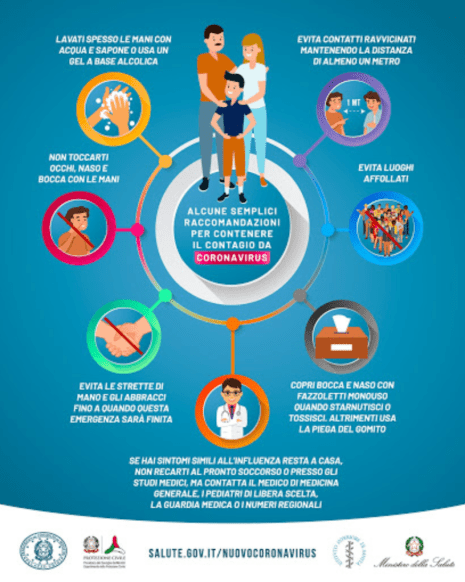
 Design For Understanding